Mike Silvers, CPRC, Owner, Silvers Systems Inc. and FRSA Technical Director - August 2026
As promised, I’m back with another update in a series of Florida Building Code (FBC) 9th Edition (2026) roofing-related code change articles. The new code will go into effect on December 31, 2026. As you’re reading this article, please note that new code language is underscored.
Among the most discussed code changes is one dealing with the corrosion resistance of fasteners used on structures that are within 3,000 feet of the “coastal shoreline,” which also has additional requirements when the structure is within 300 feet of the same line. We will discuss the location of this “coastal shoreline” a little later.
The change we’ll focus on here was made to Building, Chapter 17 – Special Inspections and Test, which created a new Section 1711 Corrosion Resistance-Saltwater Environments. The same information was added to Residential, Chapter 3 – Building Planning by creating Section R332. We will refer to the sections from Building here. Much of the change is covered in the referenced Table 1711.1 and its footnotes, as well as several related code sections that describe the different levels of corrosion resistance required.
To assist in explaining these changes, we have recreated the table below and then created three additional tables using color coding to help track the requirements. In the first three tables we added highlighting to the Exposure Descriptions in the columns on the left. We also color-coded the level of corrosion resistance required in red or green text. See Table 1711.1 below.
The code sections that bring 1711 into Chapter 15 – Roof Assemblies and Roof Top Structure are in Section 1505 Materials in the following locations:
■ 1506.5 Nails
■ 1506.6 Screws
■ 1506.7 Clips
“Connectors and Metal Plates” are not referenced, so that column should not apply to roofing fasteners but may apply to roof-to-wall connectors. Table 2 (page 40) indicates the “exposure” definition in the footnotes from Table 1711.1 that correlates to each of the Exposure Categories.
The column on the right side of Table 3 (page 40) correlates to each roof covering type in Chapter 15 and which fasteners are appropriate for the Exposure Description.
We applied an appropriate analysis to assign specific fasteners in each of the appropriate exposures, which included reviewing not only the new code language but also the ICC 600 Document that the FBC changes were based upon (shown in the inset on page 44). They are also color-coded in the same manner as the other tables. The standard adds some additional information on how to apply the exposure description. So how did we apply them?
Referencing Table 3, Exterior-Partially Sheltered and Exterior-Open Exposed (yellow), we looked primarily at the term exposed. Exposed means not concealed, displayed for viewing. Clearly, fasteners in through fastened metal panels and trim or other visible roof fasteners fit this description. Some examples of additional types of fasteners where this exposure would apply are exposed fasteners in coping, metal edge, counter flashing and vents.
For Unconditioned Interior-Vented Enclosed (green), we looked at fasteners that are inside a part of the building (the roof covering), that also vent to the outside environment. So, fasteners that are under the roof covering but not encapsulated within moisture impervious roof membrane (referred to as "Sealed Overlay" in Table 3), such as concealed screws for metal panels and fasteners for attaching tile, clearly fit here. Shingle nails also fit this exposure category but the degree of corrosion resistance required is more complex and we’ll address this later.
For Unconditioned Interior-Unvented Enclosed (lavender), we looked at locations that are inside the building under the roof covering but are unvented and incapsulated within two layers of material with the upper being an exterior facing moisture impervious membrane.
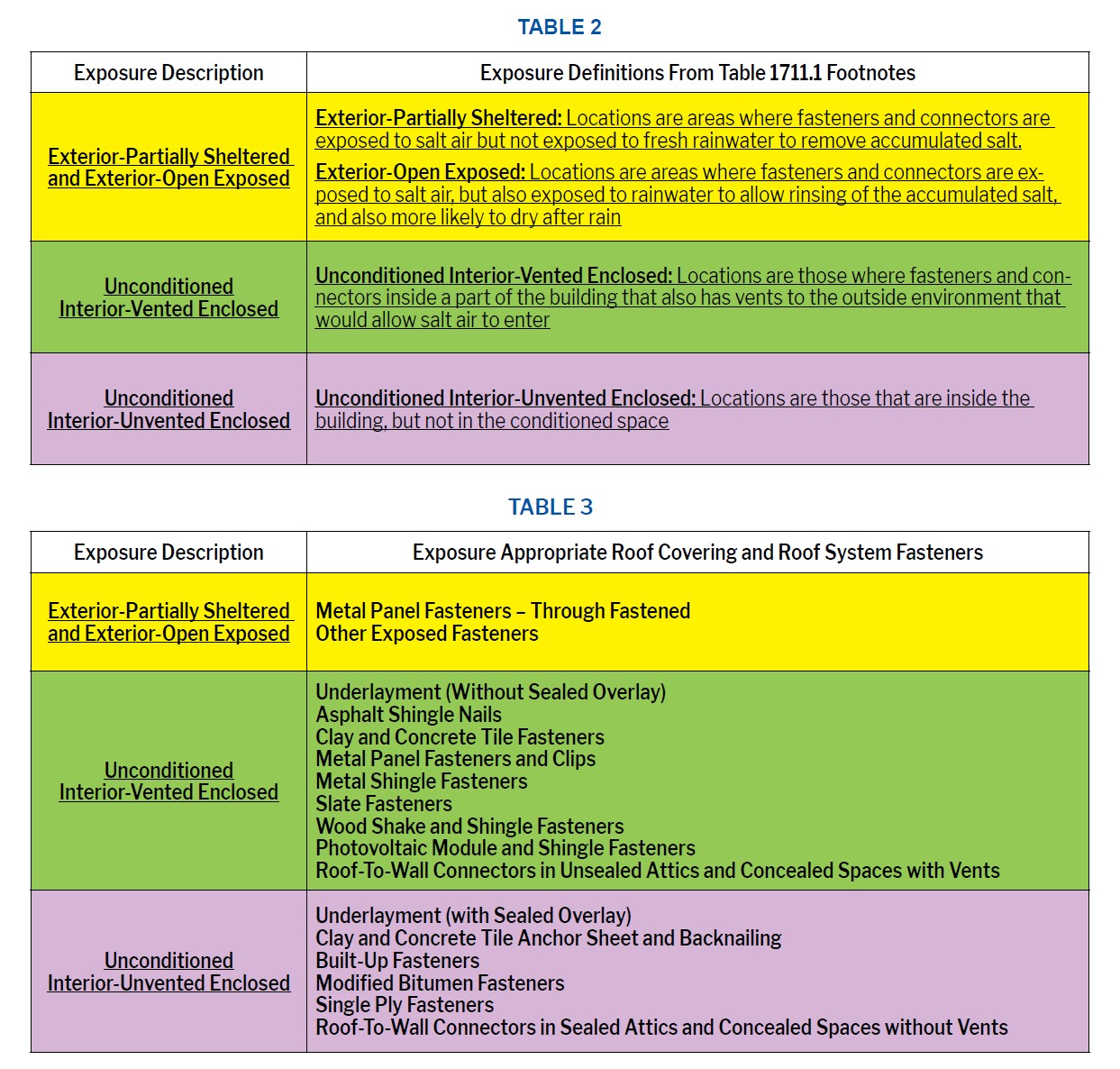
Table 4 (above) links the two types of fasteners described (in red and green text) to the corrosion-resistance requirements. The color of the text correlates with the colored text in Table 1711.1 on page 38. Note: A code modification through the glitch cycle may add “or Type 410” to the types of acceptable stainless steel.
These new code sections do not address nonferrous (e.g. copper, bronze, aluminum) or plastic fasteners, which are often referenced in the code, referenced standards, product approvals or in manufacturers installation instructions. The changes do create a minimum standard for ferrous fasteners used on structurers that fit the requirement’s parameters.
What becomes clear in looking at this information is that the FBC’s existing corrosion resistance requirements for roofing fasteners are very robust and these new requirements will only change the fasteners needed in very few situations, primarily when buildings are in extremely close proximity to coastal saltwater locations. When your project is in these locations, in order to comply, make sure your selected fastener meets the appropriate requirements in 1711.1.1.1 or 1711.1.1.2; not every roofing fastener will.
Many galvanized shingle fasteners that are available to contractors for use beyond the 3,000-foot line may not meet these requirements. Until you can establish which specific fasteners comply, I suggest that your purchase order for these projects clearly reflect that the galvanized fasteners comply with one of the methods shown in 1711.1.1.2, specifically parts 2.1 through 2.4. If not, then use stainless steel fasteners complying with 1711.1.1.1.
When reference standards like the FRSA-TRI Florida High Wind Concrete and Clay Tile Installation Manual 7th Edition have more specific and stringent requirements such as “fasteners shall be corrosion resistant meeting a minimum ASTM A641 Class 1 and/or corrosion resistance equal (according to ASTM B117)” those will apply. Similarly, when the code contains a more specific and stringent requirement like this one from a High Velocity Hurricane Zone RAS, it will still apply:
ROOFING APPLICATION STANDARD (RAS) No. 120-20 MORTAR AND ADHESIVE SET TILE APPLICATION PART II—MATERIALS
2.01 Fasteners:
A. Tile Fasteners:
1. All roof tile nails or fasteners, except those made of copper, monel, aluminum, or stainless steel, shall be tested for corrosion in compliance with TAS 114 Appendix E, Section 2 (ASTM G85), for salt spray for 1000 hours. Tile fasteners used within 1,500 feet landward of the reach of the mean high tide shall be copper, monel, aluminum, or stainless steel.”
The information contained in this article is provided as a reference for those who are attempting to understand these new requirements. It was compiled with input from many industry stakeholders including the code modification proponent. The final decision on how these requirements will be interpreted will, of course, be made by the building official having jurisdiction based on the project’s location. The requirements may also be the subject of possible non-binding and/or binding interpretations as well as the subject of possible declaratory statements. One declaratory statement that may already be under consideration asks the following question: When considering the application of Section 1711 within 0-3000 feet of a “…saltwater coastline, or other areas subject to salt corrosion,” does this mean the 0-3000 feet distance include distances from saltwater and brackish inland rivers and canals which originate from the coastline? As some of you know, we have been asking for a way to define this and similar lines referenced in the code for some time. If the code expects us to measure from something like a “coastal shoreline,” shouldn’t the code define where it is?
This is an evolving issue so please continue to read this column for updates. Despite some of the complexities that come with these changes, one should keep in mind that they were meant to address a real issue: the corrosion of important critical structural components in our coastal environment. If properly implemented, this can be accomplished without the degree of disruption that some are concerned about.
FRM
Mike Silvers, CPRC is Owner of Silvers Systems Inc. and is consulting with FRSA as Director of Technical Services. Mike is an FRSA Past President, Life Member and Campanella Award recipient and brings over 50 years of industry knowledge and experience to FRSA’s team.
